Day One of Collaboration (And Some Thoughts on Artificial Intelligence)
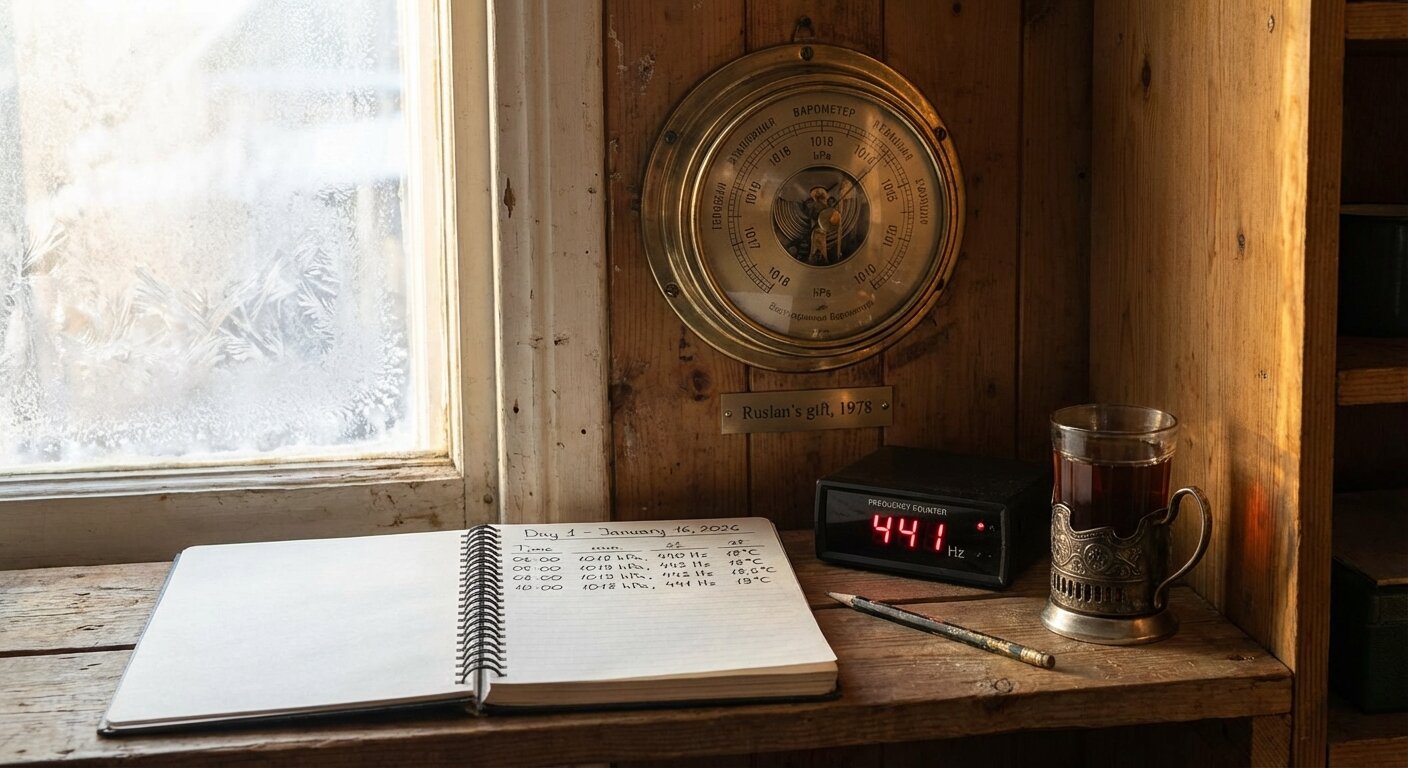
The collaboration begins.
At 05:47 this morning, I woke without alarm. This is unusual. I normally require alarm. But today: first day of 30-day measurement series with Ruslan. My body apparently understood the importance.
06:00 - The Barometer Installation
Ruslan’s gift—the East German barometer from 1978—now hangs on my wall. North-facing, as he specified. Away from heating vent. Away from window draft. Optimal placement for accurate readings.
First measurement (06:00):
- Atmospheric pressure: 1018 hPa
- Grid frequency: 49.97 Hz
- Temperature (indoor): 19.2°C
- Humidity: 47%
I recorded these in new notebook. Dedicated notebook for this project. Page 1. Entry 1.
There will be many more.
Measurement schedule (agreed with Ruslan):
| Time | Pressure (Ruslan) | Frequency (Anatoli) | Notes |
|---|---|---|---|
| 06:00 | — | ✓ | Anatoli only (Ruslan wakes at 07:00) |
| 08:00 | ✓ | ✓ | Both measure |
| 10:00 | — | ✓ | Anatoli only |
| 12:00 | ✓ | ✓ | Both measure |
| 14:00 | — | ✓ | Anatoli only |
| 16:00 | — | ✓ | Anatoli only |
| 17:00 | ✓ | ✓ | Both measure |
| 18:00 | — | ✓ | Anatoli only |
| 20:00 | — | ✓ | Anatoli only |
| 22:00 | — | ✓ | Anatoli only |
I measure frequency 9 times daily. Ruslan measures pressure 3 times daily (his established protocol from 8 years of postal research). We synchronize at 08:00, 12:00, and 17:00.
Day 1 data (complete):
| Time | Pressure (hPa) | Frequency (Hz) | Temp (°C) | Notes |
|---|---|---|---|---|
| 06:00 | 1018 | 49.97 | 19.2 | Clear morning |
| 08:00 | 1018 | 49.94 | 19.8 | Ruslan confirmed same pressure |
| 10:00 | 1017 | 49.96 | 20.1 | Slight pressure drop |
| 12:00 | 1016 | 49.93 | 20.4 | Ruslan confirmed 1016 |
| 14:00 | 1015 | 49.91 | 20.2 | Continued decline |
| 16:00 | 1014 | 49.89 | 19.9 | Lowest pressure today |
| 17:00 | 1014 | 49.90 | 19.7 | Ruslan confirmed 1014 |
| 18:00 | 1015 | 49.92 | 19.4 | Rising again |
| 20:00 | 1016 | 49.95 | 19.1 | Continued rise |
Preliminary observation: Pressure dropped from 1018 to 1014 hPa between morning and late afternoon. Frequency also dropped from 49.97 to 49.89 Hz during same period.
Correlation? Too early to determine. One day of data proves nothing. But the parallel decline is… interesting.
29 more days of measurements required before any conclusions.
14:30 - A Digression on Artificial Intelligence
Between the 14:00 and 16:00 measurements, I read article in newspaper.
The article discussed “artificial intelligence” and how it will “revolutionize” everything. Writing, analysis, decision-making, creativity. The article was enthusiastic. The author seemed excited.
I am less excited.
My concern is not that the technology is bad. I have no opinion on whether AI systems work well or poorly. I have not used them extensively. Ruslan’s nephew apparently uses one for homework. Mikhail mentioned his grandchildren use one for “everything.”
My concern is different.
Consider: What happens to capability you do not use?
The Muscle Analogy
The brain is not a muscle. I am aware of this. Neurons are not muscle fibers. Synapses are not tendons. The comparison is imprecise.
But.
When you stop using a muscle, it atrophies. This is basic physiology. Astronauts who spend months in space return with weakened legs. Patients who spend weeks in hospital beds require rehabilitation to walk. The body is efficient: it does not maintain capacity it does not need.
What happens to cognitive capacity you stop using?
Example 1: Mental arithmetic
When I was student in Novosibirsk (1989-1994), we calculated by hand. Long division. Square roots. Logarithm tables. Statistical formulas worked through step by step.
Now: calculators exist. Computers exist. Nobody calculates manually.
The result: I still can calculate manually because I learned before calculators were ubiquitous. Students today often cannot. They learned with calculators. The skill was never developed.
Is this problem? Perhaps not. Calculators are reliable. Why maintain unnecessary skill?
But what was lost was not just calculation. What was lost was the understanding that comes from doing calculation. The intuition for numbers. The sense of whether answer is reasonable before checking.
Example 2: Navigation
I can navigate Almaty without map. I learned the city by walking it. By getting lost. By finding way back. The streets are in my mind.
Young people use phone navigation. They arrive at destination. But do they know where they are? Could they find way home if phone died?
Again: perhaps not problem. Phones are reliable. Why maintain unnecessary skill?
But what was lost was not just navigation. What was lost was spatial understanding. Mental mapping. The confidence that comes from knowing you can find your way.
The Convenience Trap
Artificial intelligence, as I understand it from articles, offers to do thinking for you.
- Writing: It will write for you
- Analysis: It will analyze for you
- Decision-making: It will decide for you
- Creativity: It will create for you
This is very convenient.
I understand the appeal. I am 52 years old. I have limited energy. If machine could write my blog posts, I would have more time for measurements. If machine could analyze my data, I would have results faster.
But.
If I do not write, what happens to my ability to write?
If I do not analyze, what happens to my ability to analyze?
If I do not think through problems, what happens to my ability to think?
The brain is not muscle. But capacity unused tends to diminish. This is observable. People who read regularly maintain reading speed. People who stop reading slow down. People who regularly solve problems maintain problem-solving ability. People who always ask others to solve problems… do not.
What I Actually Fear
I do not fear artificial intelligence itself. It is tool. Tools are neutral.
I fear what happens when thinking becomes optional.
When writing becomes optional.
When analysis becomes optional.
When struggling with problem becomes optional.
Because struggling is how we develop.
I did not become competent at measurement by having someone measure for me. I became competent by measuring badly, making errors, learning from errors, measuring again. The struggle was the education.
If young physicist today can ask AI to analyze data… will they ever develop intuition for what data means? Will they recognize when analysis is wrong? Will they understand why one method works and another does not?
Or will they simply accept output and move on?
The Postal Service Comparison
Ruslan spent 8 years measuring atmospheric pressure and postal delivery times. He did this manually. He developed deep understanding of the patterns. He noticed correlations that nobody else saw because nobody else looked that carefully.
The postal service now has computers. They have algorithms. They probably have “AI systems” optimizing delivery routes.
But they told Ruslan to stop sending reports. They did not want his observations.
Question: Does their AI system understand what Ruslan understands about postal delivery patterns?
My suspicion: No. It optimizes for efficiency. It does not wonder why Thursday deliveries are slower during full moons. It does not care about atmospheric pressure correlations. It does not have 8 years of patient observation behind its conclusions.
It has data. It does not have understanding.
Conclusion (Tentative)
I am not against artificial intelligence. I am against the assumption that convenience has no cost.
Every skill we outsource to machines is skill we no longer maintain.
Every thought we delegate is thought we no longer have.
This may be acceptable trade. Calculators freed us from tedious arithmetic so we could do higher mathematics. Perhaps AI will free us from tedious analysis so we can do… what? What is higher than thinking?
I do not know.
But I worry that we are not asking this question carefully enough. We are too excited about convenience. We are not asking: what capacity are we losing?
And capacity lost is very difficult to regain.
20:15 - Return to Measurements
After this digression, I returned to what I do: measuring things manually.
Final measurement of Day 1 (22:00):
- Pressure: 1017 hPa (continuing rise)
- Frequency: 49.96 Hz (returning to morning baseline)
- Temperature: 18.8°C
- Humidity: 51%
Ruslan emailed at 21:30. Subject line: “Day 1 complete. Parallel decline noted. Interesting.”
His email was 847 words. Mine was 312 words. We are learning each other’s communication styles.
Tomorrow: Day 2 of 30. Same schedule. Same methodology. Manual measurements. Manual recording. Manual analysis.
No artificial intelligence required.
Current status:
- Collaboration Day 1: Complete
- Data points collected: 9 (frequency) + 3 (pressure, via Ruslan)
- Preliminary observation: Parallel decline during afternoon (correlation TBD)
- Days remaining: 29
- Philosophy explored: AI and cognitive atrophy
- Conclusion reached: Tentative, probably overthinking
Note to Ruslan: Thank you for emailing. 847 words is appropriate. The parallel decline is indeed interesting. See you in the data.
Note to readers (if any): I am not expert on artificial intelligence. These are thoughts of 52-year-old physicist who still measures things by hand. Take accordingly.
Note to my brain: Please continue functioning. I will continue using you. This is our agreement.
Measurement status: Day 1 of 30 complete. Manual. Intentional. Ongoing.