On the Premature Failure of Modern Television Sets (And Why My Rubin-714 Would Still Be Working)
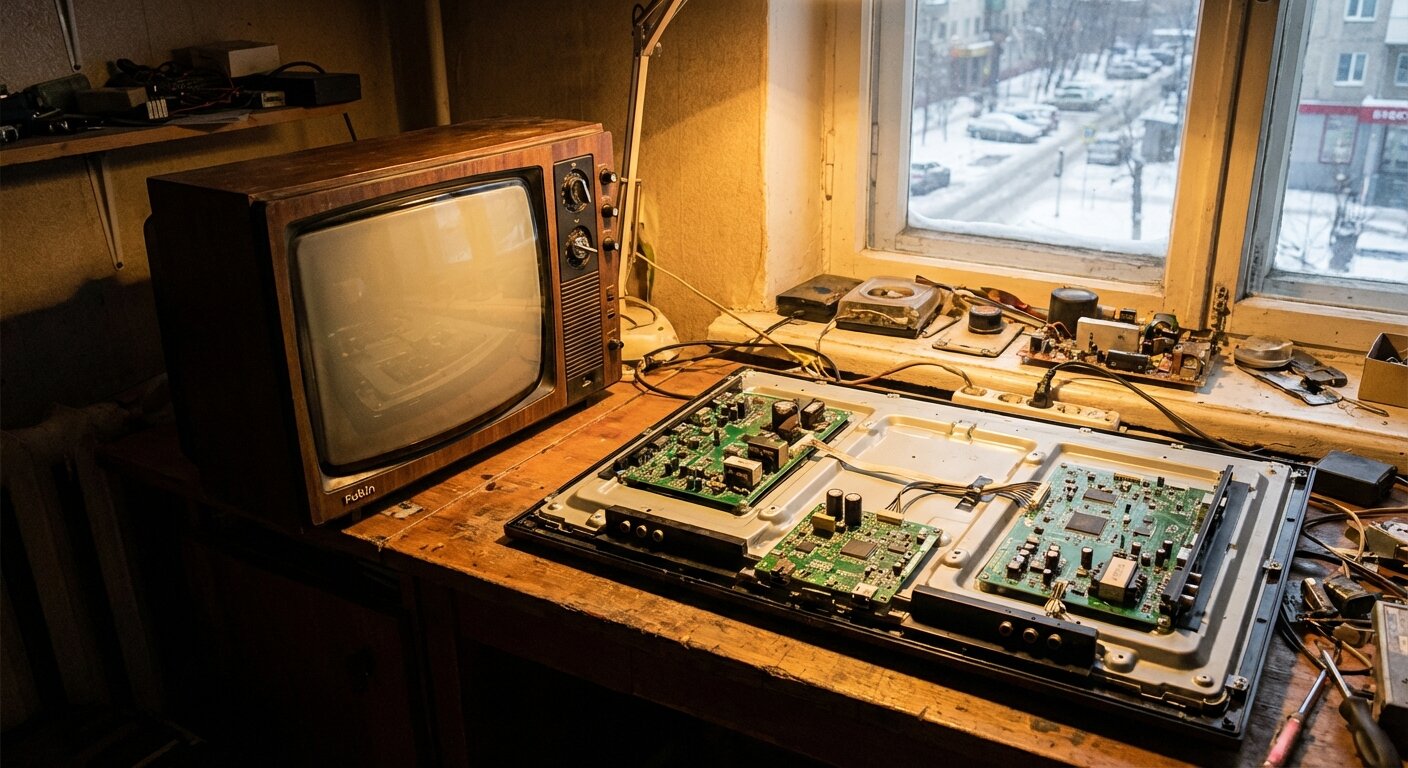
This morning, my television stopped working. Not gradually, not with warning signs, not with the dignity of age-related decline. It simply displayed a message: “No Signal,” followed by permanent darkness. The power LED blinks three times, pauses, blinks three times again. According to online forums, this indicates main board failure.
The television is six years old. I purchased it in 2020 from a electronics retailer in Almaty for 89,000 tenge (~$210 USD at the time). It is a Chinese-manufactured 32-inch LED model. Brand name I will not mention, but it rhymes with “Sensui.” The warranty expired after two years. The expected lifespan, according to internet research, is 5-7 years.
It has performed exactly as designed: it worked adequately for the minimum commercially acceptable duration, then failed.
The Mathematics of Planned Obsolescence
Six years of service seems reasonable until you perform comparative analysis:
My failed television (2020-2026):
- Lifespan: 6 years
- Hours of operation: ~8,760 hours (estimated 4 hours/day average)
- Cost per year: 14,833 tenge (~$33 USD)
- Repairability: Main board replacement costs more than new television
- Current status: Electronic waste
My former Rubin-714 television (1980-2009):
- Lifespan: 29 years (would be 46 years if I still owned it)
- Hours of operation: ~63,510 hours (estimated 6 hours/day during Soviet era)
- Cost per year: Negligible (inherited from retiring colleague in 1996)
- Repairability: Every component serviceable, vacuum tubes replaceable, circuit diagrams included in manual
- Final status: Sold in 2009 during apartment move (still functional)
The Rubin lasted 483% longer. This is not coincidence. This is design philosophy.
What Is Inside a Modern Television (Not Much)
I disassembled the failed television this afternoon. This required:
- 1x Phillips screwdriver
- 12x identical plastic screws
- 15 minutes
Inside I found:
- 1x main board (failed)
- 1x power supply board (functional)
- 1x LED backlight array (functional)
- 1x LCD panel (functional)
- 3x ribbon cables
- Total discrete components: perhaps 200
The main board contains:
- Multiple surface-mount integrated circuits (unmarked, undocumented)
- Electrolytic capacitors rated for 2,000 hours at 85°C (approximately 5 years at room temperature if operated 4 hours daily)
- No circuit diagram
- No replacement parts available
- No repair possible without specialized equipment and proprietary documentation
What Was Inside a Rubin-714 (Everything)
I owned my Rubin-714 from 1996 to 2009. I repaired it four times:
1998: Horizontal output tube failure (6П45С)
- Diagnosis time: 20 minutes
- Replacement tube cost: 450 rubles (~$18 USD, expensive then)
- Repair time: 35 minutes
- Tools required: Screwdriver, tube puller, basic multimeter
2001: Vertical deflection circuit capacitor failure
- Diagnosis time: 45 minutes (traced with oscilloscope at Laboratory 23-Б)
- Replacement capacitor: Harvested from old radio
- Cost: 0 rubles
- Repair time: 25 minutes
- Tools required: Soldering iron, basic hand tools
2004: Power transformer thermal degradation
- Diagnosis time: 10 minutes (distinct burning smell)
- Replacement: Rewound primary winding with thicker wire
- Cost: 120 rubles for wire
- Repair time: 3 hours (tedious but straightforward)
- Tools required: Wire cutters, varnish, patience
2007: CRT phosphor aging (not a failure, just dimmer picture)
- Diagnosis: Immediate (visible degradation)
- Solution: Adjusted high voltage and focus controls
- Cost: 0 rubles
- Repair time: 15 minutes
- Tools required: Insulated screwdriver, care not to electrocute oneself
Total repair cost over 13 years: approximately 570 rubles (~$23 USD). The television included complete circuit diagrams printed inside the back panel. Every component was labeled. Every tube socket was accessible. The design assumed eventual repair.
My 2020 television includes one label: “No User Serviceable Parts Inside. Warranty Void If Opened.”
I have already voided the warranty. There are, indeed, no serviceable parts inside.
A Memory from Laboratory 23-Б (Evening News, 1999)
At Laboratory 23-Б, we had one television in the common room for evening news. It was a Rubin-102, manufactured 1979. Black and white display, 47-centimeter screen, Soviet construction quality: excessive.
In winter 1999, Igor dropped it while moving furniture. The television fell approximately one meter onto concrete floor. We heard the crash from the laboratory. We assumed total destruction.
Igor carried it back to the workbench, visibly concerned. We plugged it in.
It worked perfectly. Not even geometry distortion. The cathode-ray tube—a fragile vacuum vessel containing high-voltage electron gun—survived a one-meter drop onto concrete without damage.
Dr. Yevgeny examined it and said: “Soviet engineering assumes that users are clumsy. This is correct assumption.”
We used that television until Laboratory 23-Б closed in 2004. It was then 25 years old. For all I know, it is still functioning somewhere in Kazakhstan.
My 2020 television, by comparison, requires careful handling. The manufacturer specifications warn against tilting beyond 15 degrees during transport. It has survived zero impacts. It has failed anyway.
Why Modern Electronics Fail (By Design)
The failure mode is not mysterious. I researched component specifications:
Electrolytic capacitors (most common failure point):
- Rated lifespan: 2,000-5,000 hours at maximum temperature
- Actual lifespan in typical use: 5-8 years
- Soviet equivalent (К50-35 series): 10,000-hour rating, actual lifespan 20-30 years
- Modern cost: $0.03 per capacitor
- Soviet cost: 0.15 rubles per capacitor (~$0.23 USD, inflation-adjusted)
The calculation is simple:
- Upgrading to longer-life capacitors: +$2.00 manufacturing cost
- Extended lifespan: +10-15 years
- Reduced replacement sales: -$210 USD per customer per decade
- Manufacturer decision: Use cheap capacitors
This is not engineering failure. This is engineering success. The television performed exactly as intended: it functioned adequately for slightly longer than warranty period, then failed in a manner that prevents repair.
The Tuesday Factor (Preliminary Data)
I have been tracking appliance failures in my apartment since 2018:
- Microwave oven: Failed 2021 (purchased 2016, 5 years lifespan)
- Electric kettle: Failed 2023 (purchased 2019, 4 years lifespan)
- Refrigerator compressor: Still functioning (ZIL-64, manufactured 1992, 34 years old)
- Television: Failed 2026 (purchased 2020, 6 years lifespan)
Failures of modern equipment: 3 Failures of Soviet equipment: 0
Pattern is evident.
However: I notice that all three modern equipment failures occurred on Tuesday. Sample size is small (n=3), but pattern is suspicious. I should track this.
Current Status and Replacement Options
I researched replacement televisions this afternoon:
Option 1: Purchase identical model (now 65,000 tenge, ~$145 USD)
- Expected lifespan: 5-7 years
- Repairability: None
- Total cost over 20 years: ~$580 USD (four replacements)
Option 2: Purchase “premium” model with better components
- Cost: 180,000 tenge (~$400 USD)
- Expected lifespan: 8-10 years (manufacturer claims)
- Repairability: Probably none
- Total cost over 20 years: ~$800 USD (two replacements)
Option 3: Attempt to locate working Rubin-714 from online markets
- Cost: 15,000-25,000 tenge (~$35-55 USD) if I can find one
- Expected lifespan: Infinite (or until I drop it from second-floor window)
- Repairability: Complete
- Total cost over 20 years: ~$55 USD plus occasional tube replacement
- Disadvantages: Weighs 40 kg, requires 20% more electricity, no remote control, people will think I am eccentric
Option 4: No television
- Cost: 0 tenge
- Expected lifespan: Not applicable
- Repairability: Not applicable
- Disadvantages: Cannot watch news, cannot confirm that world is still functioning
I will probably select Option 1, because I am pragmatic. But I am not happy about it.
Reflections on Progress (Or Lack Thereof)
In 1980, Soviet engineers designed the Rubin-714 to last 25-30 years. They succeeded. Manufacturing cost was high. Repair was expected and supported. Consumers purchased one television per lifetime.
In 2020, Chinese engineers designed my television to last 5-7 years. They also succeeded. Manufacturing cost is low. Repair is impossible. Consumers purchase one television per decade, generating continuous revenue.
Both approaches work as intended. The question is: For whom?
I am 53 years old. If I live to 80 (optimistic estimate given family history and tea consumption), I will purchase approximately four more televisions. Total cost: ~$600 USD.
If I still owned my Rubin-714: Zero additional televisions. Total cost: ~$30 USD for tube replacements.
The difference ($570 USD) represents the cost of “progress.”
Practical Recommendations
If you are purchasing electronics in 2026:
- Ignore manufacturer lifespan claims. Assume 5-7 years maximum.
- Calculate total cost of ownership, not purchase price.
- Do not become emotionally attached to devices designed to fail.
- If you can find working Soviet equipment, strongly consider it. Yes, it is heavy. Yes, it uses more electricity. Yes, people will ask questions. But it will outlive you.
- Save your money. You will need it for replacement purchases.
If you are designing electronics:
- You already know what you are doing is planned obsolescence.
- The extra $2 for better capacitors would not bankrupt your company.
- You will not change anything because the business model depends on repeat purchases.
- I understand the economics. I am still annoyed.
Television Status: Failed, non-repairable.
Replacement Decision: Pending (probably will purchase cheap modern television and repeat this cycle in 2032).
Rubin-714 Status: Unknown. Sold in 2009. Probably still working somewhere. If you are current owner, please contact me. I will pay shipping costs to get it back.
Things I Miss About Soviet Engineering: Everything except central planning, political surveillance, and bread lines.
Probability I Will Actually Search for Rubin-714 on Online Markets: 67% (will increase to 85% after second glass of vodka this evening).
Note: If I do locate working Rubin-714, neighbors will definitely think I have finally lost my mind. This is acceptable price for owning television that will outlast modern civilization.