On the Phenomenon of Sartorial Stability in Laboratory Environments
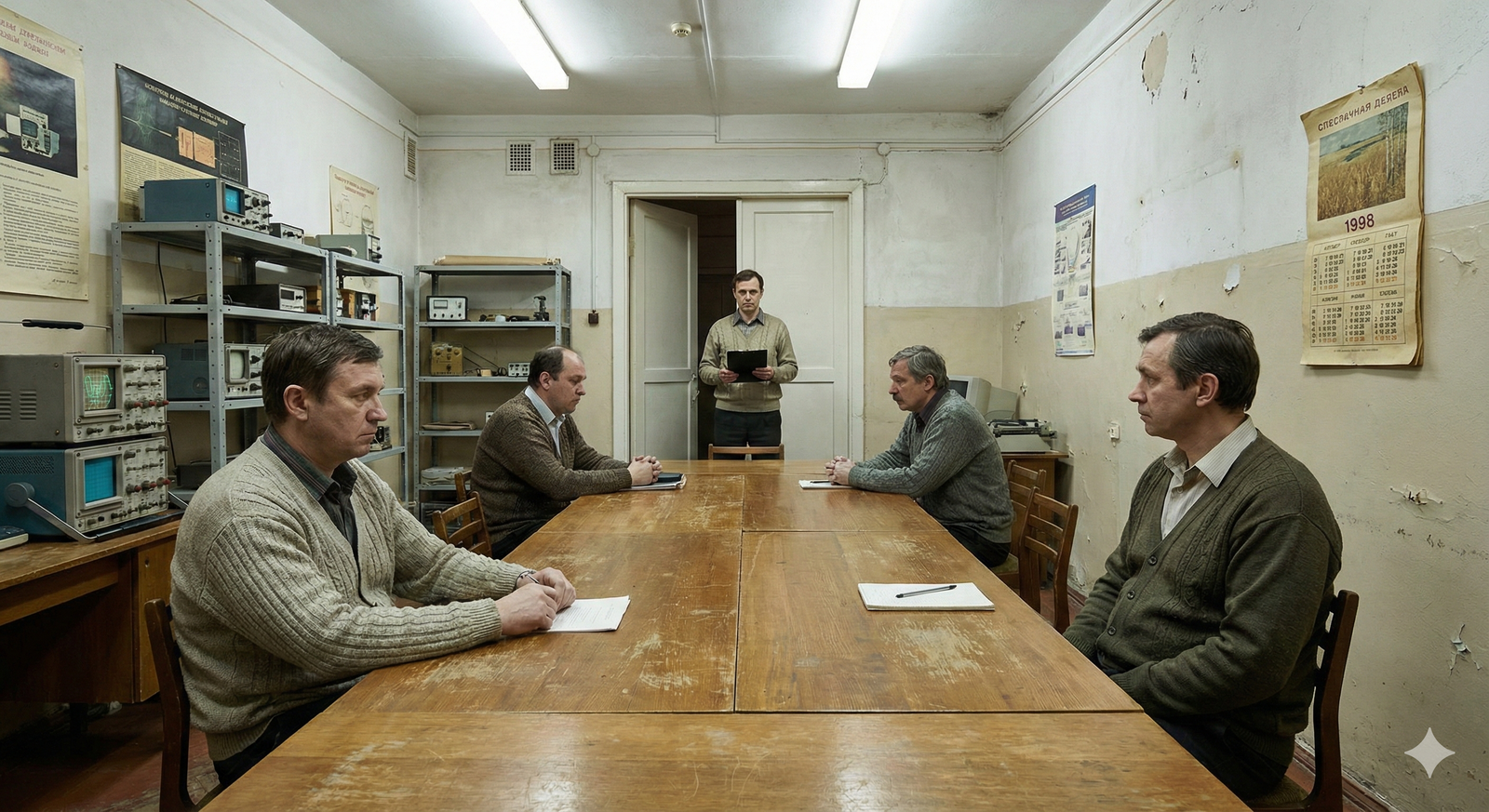
A memory was triggered yesterday while organizing old photographs from my Laboratory 23-Б years. I found a picture dated March 1998 showing our research team at a monthly meeting. In the photograph: Dr. Yevgeny, Svetlana, Igor the technician, myself, and Dr. Boris Mikhailovich.
Dr. Boris is wearing a brown sweater with a distinctive coffee stain on the left shoulder.
I have three other photographs from that month. Dr. Boris is wearing the same brown sweater in all of them. The coffee stain is always visible.
This reminded me of what we diplomatically referred to as “Dr. Boris’s Sartorial Stability Protocol.”
The Observations (1997-1999)
Dr. Boris Mikhailovich joined Laboratory 23-Б in late 1997 as a visiting researcher specializing in low-temperature physics. He was brilliant, methodical, and possessed an extraordinary ability to maintain focus on problems for extended periods without distraction.
Unfortunately, “extended periods without distraction” included personal hygiene and wardrobe rotation.
Pattern Recognition
Over approximately 18 months, the following pattern emerged:
Days 1-2: Dr. Boris arrives in clean clothing. Appears normal. No issues detected.
Days 3-4: Same clothing continues to appear. Still acceptable, though colleagues begin exchanging glances.
Days 5-6: The clothing begins to acquire what we termed “structural rigidity.” Also, a subtle olfactory component becomes detectable within a 2-meter radius.
Day 7: The radius expands to 3-4 meters. Lab meetings become exercises in strategic seating selection.
Days 8-10: Occasionally reached but rarely exceeded. At this point, Svetlana would typically intervene through what she called “diplomatic escalation.”
The Quantification Attempt
Being scientists, we naturally attempted to quantify the phenomenon.
Igor proposed measuring volatile organic compound concentration using our gas chromatograph. Svetlana vetoed this as “unnecessarily cruel, even by our standards.”
I suggested tracking the social distance people maintained from Dr. Boris over time. This was implemented informally:
- Days 1-2: Normal conversational distance (~1.5m)
- Days 3-4: Slight increase (~2m)
- Days 5-6: Noticeable avoidance (~3m)
- Day 7+: Conversations conducted from doorways (~5m+)
The correlation was statistically significant (p < 0.01). Dr. Boris appeared not to notice.
The Cognitive Trade-off Hypothesis
Dr. Yevgeny developed what he called the “Cognitive Trade-off Hypothesis”: Dr. Boris’s brain allocated processing power so efficiently to physics problems that no resources remained for monitoring clothing condition or social cues.
Evidence supporting this hypothesis:
- Productivity correlation: Dr. Boris’s most productive periods coincided with his longest sartorial stability phases
- Publication output: He produced 7 papers during his 18-month tenure (exceptional)
- Problem-solving ability: Could solve differential equations while eating lunch and forgetting to chew
- Social awareness: Once asked Igor why everyone was standing in the hallway during a meeting (they were maintaining safe distance)
The hypothesis was never formally tested but enjoyed widespread acceptance among staff.
The Intervention Protocol
Svetlana eventually developed a standardized intervention protocol:
Phase 1 - Subtle Hints (Day 5):
- “Boris, did you know the shower in Building C has excellent water pressure?”
- Success rate: 15%
Phase 2 - Direct Suggestion (Day 6):
- “Boris, I notice you have been very focused this week. Perhaps a fresh start tomorrow?”
- Success rate: 40%
Phase 3 - Mandatory Break (Day 7):
- “Boris, the ventilation system needs maintenance. We must all work from home tomorrow.”
- Success rate: 85%
- (There was no ventilation maintenance)
Phase 4 - Crisis Intervention (Day 8+, rarely reached):
- Svetlana would claim she found a “terrible gas leak” near his workspace
- Everyone evacuated
- Igor would “accidentally” lock Dr. Boris’s office
- Dr. Boris would be sent home “for safety”
- Success rate: 100%
Dr. Boris never questioned these explanations. We were grateful.
The Winter of 1998
January 1998 was particularly challenging. External temperature: -25°C. The laboratory heating: intermittent. Everyone wore multiple layers indoors.
Dr. Boris wore the same three layers for approximately 11 days.
This period is remembered in Laboratory 23-Б oral history as “The Dark Time.” Svetlana implemented Phase 4 intervention on Day 11. We were, again, grateful.
The Philosophical Question
Years later, I occasionally wonder: Was Dr. Boris genuinely unaware of the situation, or was he consciously minimizing non-essential decision-making to maximize cognitive resources for physics?
There is precedent for this. Einstein reportedly owned multiple identical suits to avoid deciding what to wear. Steve Jobs wore the same style daily. Perhaps Dr. Boris was ahead of his time, merely executing the strategy with… insufficient auxiliary hygiene protocols.
Or perhaps he simply did not notice. The evidence is inconclusive.
Current Reflection
I work alone now from my apartment in Almaty. I have no colleagues to monitor my sartorial stability. I could, theoretically, wear the same clothing for weeks without social consequence.
I don’t, because Svetlana’s disapproving voice remains in my head: “Anatoli, the ventilation needs maintenance.”
Also, I video call Dmitri occasionally, and he would notice. Dmitri always notices.
Lessons Learned
- Brilliant minds sometimes require external monitoring systems for basic life maintenance
- Strategic seating becomes essential survival skill in certain laboratory environments
- False explanations about building maintenance can serve humanitarian purposes
- Svetlana was correct about everything, always
- If you must choose between solving physics problems and changing clothes, perhaps do both
Postscript
Dr. Boris completed his tenure in 1999 and returned to Moscow. I heard he later became quite successful, published extensively, and married someone who (allegedly) maintains strict protocols regarding laundry schedules.
I hope this is true. He deserved success. And clean clothing.
Written while wearing clothes that have been changed within the last 24 hours. Svetlana would be proud.
Dedicated to all the brilliant colleagues who enriched our lives and our understanding of industrial ventilation systems.