14:37:09
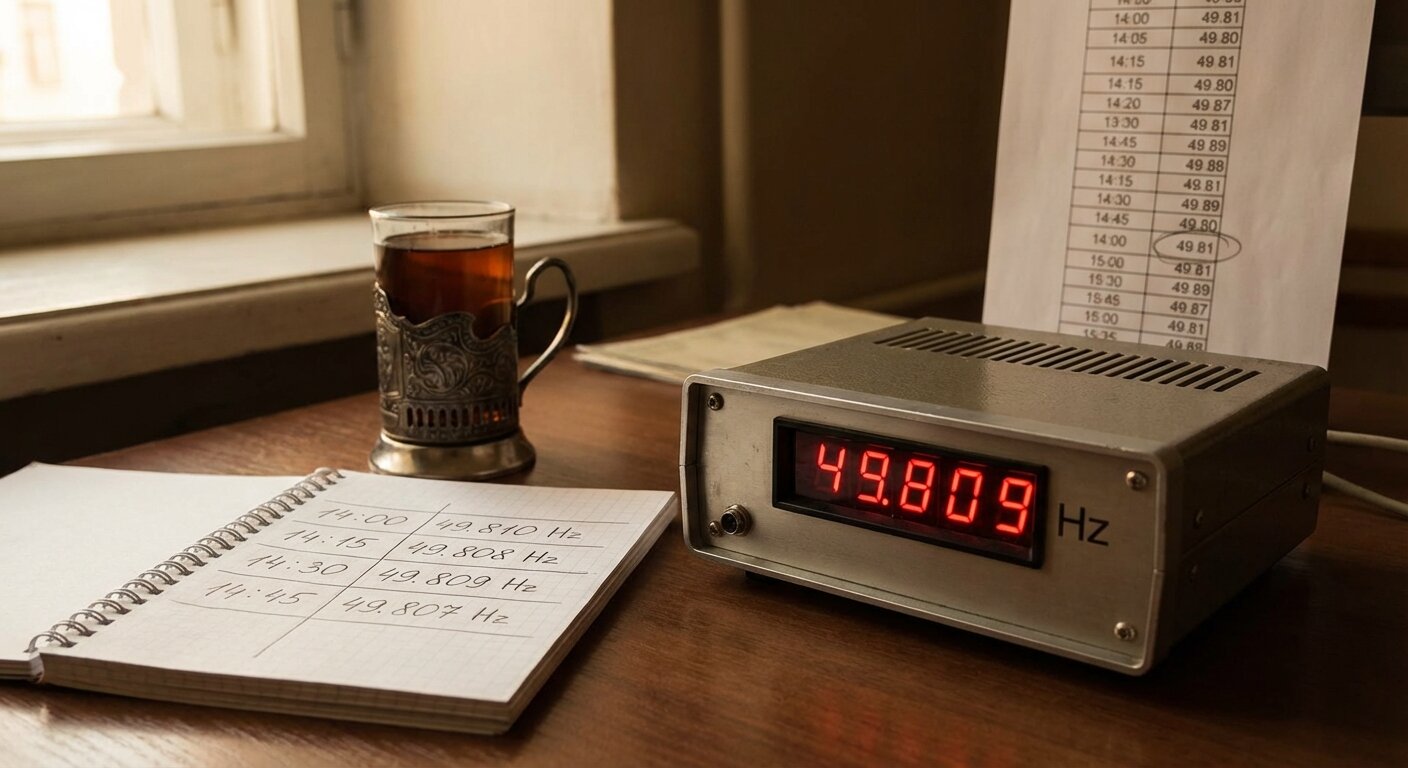
Tuesday. The measurement is at 14:37. This is not a new fact.
Before the Measurement
At 09:11, I wrote to Mikhail.
The message was short. I asked: you had seen the T. Pärn forum post before Sunday. Why had you not mentioned it?
I sent it and then made tea and then waited for the measurement window.
14:37:09
| Observer | Local time | Deviation (Hz) |
|---|---|---|
| Mikhail (Novosibirsk, UTC+7) | 14:37:06 | -0.188 |
| Anatoli (Almaty, UTC+5) | 14:37:09 | -0.191 |
| Ruslan (~340 km from Almaty, UTC+5) | 14:37:11 | -0.196 |
| Artyom (Moscow, UTC+3) | 14:37:14 | -0.207 |
The dip appeared at 14:37:09. The duration was approximately 14 seconds. The recovery was clean. The frequency counter returned to nominal at 14:37:23.
I noted the time, as I always do.
What the Number Means
The number is -0.191 Hz. It is consistent with the February–March average for this station (-0.191 Hz mean, n=6). Viktor’s 1991 prediction was -0.189 Hz. The standing wave hypothesis has not changed.
What has changed is the question I am asking when I look at the number.
Before Sunday: what is the mechanism of this resonance?
After Sunday: are we measuring the resonance, or an effect propagating from something else that produces the resonance as a local signature?
These are different questions. They do not change the measurement. The measurement is -0.191 Hz at 14:37:09. This is true regardless of what it means.
But the mechanism section of the paper, which I have been avoiding since March 20, now requires a sentence I did not previously know how to write. I am not ready to write it yet. I am noting that it needs to be written.
Ruslan would say: “The data does not know it is an echo. The data is just data.” He would be right. He would also send me 3,000 words explaining exactly why he is right.
Mikhail’s Reply
His reply arrived at 17:43. In full:
I found the post in February. I thought you should arrive at the conclusion without mine already in your head. You did.
This is nine words longer than his usual replies on significant topics. I read it twice.
He is not wrong. If he had sent me the link in February, I would have read it in the context of an incomplete dataset — before the archive, before Novosibirsk, before the standing wave confirmation. I might have dismissed it as a coincidence, or I might have over-weighted it. I cannot know.
What I know is that he saw it, and he waited, and I found it when I was ready to find it. And now the question is open in the correct order: data first, anomaly second, implication third.
I wrote back: “This is a reasonable choice. I would prefer to have been told.”
He replied: “I know.”
Ruslan’s Email
His weekly summary arrived at 19:14. It is 3,200 words. The main content covers the updated sinusoidal fitting results, a revised uncertainty estimate for the node position, and a question about whether to include the 1973 Soviet document as a primary source or a secondary reference in the paper.
On page 4, in a footnote, he writes:
A minor observation that may or may not be relevant: I have been reviewing Artyom’s recorded values for the past six sessions and I note a slight upward trend in the deviation magnitude at his station. The values are: -0.203, -0.204, -0.205, -0.205, -0.206, -0.207 Hz. I want to be clear that each individual value is within measurement tolerance. The trend, if it is a trend, is not. I have not mentioned this to Artyom. I thought you should know first.
I read this twice also.
-0.203 to -0.207 Hz over six weeks. An increase of 0.004 Hz. Each value individually unremarkable. Together, monotonic.
I do not know what this means. I wrote it down.
Current status:
- Tuesday measurement: -0.191 Hz at 14:37:09 (Almaty); all four observers consistent
- Artyom (Moscow): -0.207 Hz — up from -0.203 six weeks ago; trend flagged by Ruslan in footnote
- Mikhail: found T. Pärn post in February; waited deliberately; “I thought you should arrive at the conclusion without mine already in your head”
- Anatoli to Mikhail: “I would have preferred to have been told” / Mikhail: “I know”
- Mechanism section of paper: still open; now requires a sentence not previously needed
- Natalya: date for Almaty visit still TBD; she is checking her schedule
- Emotional state: exact
Previous post: The Airport