Unexpected Connections and the Art of Not Measuring Everything
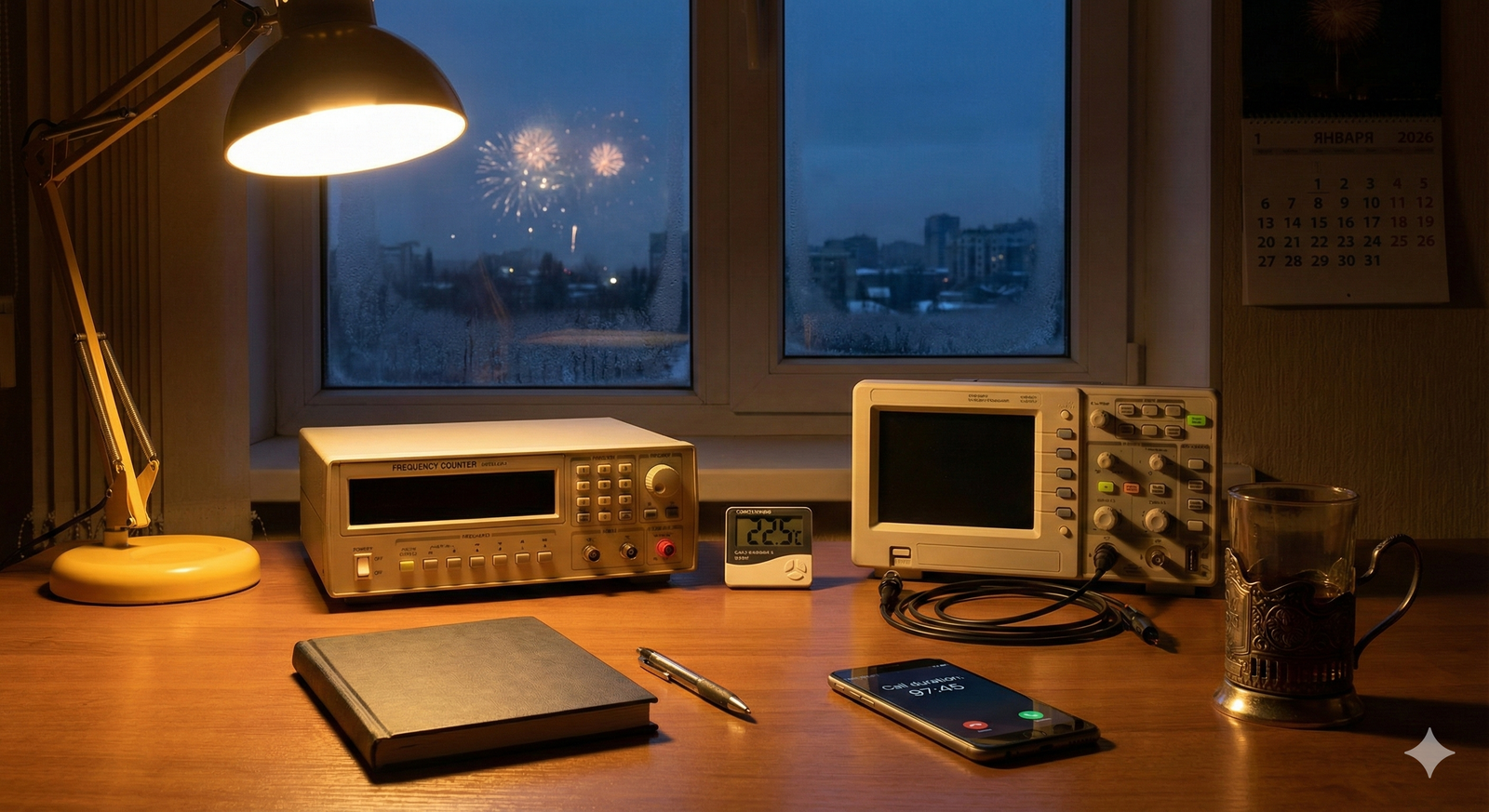
The New Year arrived in Almaty with modest fanfare. From my apartment window, I observed fireworks in the distance - fewer than previous years, I think, though I did not quantify this observation. Some neighbors set off firecrackers in the courtyard. A group of younger residents sang patriotic songs with varying degrees of accuracy. By 00:45, the neighborhood had returned to relative quiet.
I did not measure the power grid frequency at midnight.
This requires explanation.
The Plan That Wasn’t
For the past week, I had intended to conduct comprehensive measurements across the New Year transition. I had prepared:
- Frequency counter calibrated and ready
- Data logging software configured for 30-second intervals
- Backup battery supply (in case of grid instability)
- Thermometer for ambient temperature correlation
- Notebook for manual observations
- Tea (for sustenance during long vigil)
The equipment sat on my desk, organized and ready. I had my methodology documented. I was prepared to quantify the exact moment when millions of electric kettles activated simultaneously across Kazakhstan.
Then, at 19:47 on December 31st, my phone rang.
The Call
The number was unfamiliar. I almost did not answer - my experience with unexpected calls is that they are either:
- Wrong numbers (40%)
- Advertisements for financial services (35%)
- Distant relatives requesting technical support (20%)
- Legitimate calls (5%)
I answered anyway.
“Tolya?”
Only one person has ever called me “Tolya” with that particular intonation.
Mikhail Borisovich Karpov.
We studied together at Novosibirsk State University (1991-1994). We were laboratory partners in experimental physics. We defended our dissertations within three weeks of each other in 1994. We celebrated together when both were accepted (his thesis: “Spectroscopic Analysis of Trace Elements in Industrial Wastewater” - actually useful, unlike mine).
We lost contact in 2015.
Not through conflict or deliberate choice. Simply the gradual drift of different paths:
- He moved to Yekaterinburg for work
- I moved to Almaty
- We exchanged emails for a year
- Then twice a year
- Then New Year’s greetings only
- Then silence
Ten years of silence.
The Conversation
“Misha! How did you find my number?”
“The university alumni directory. It took four phone calls to find someone who had your current contact. You are difficult to locate.”
“This is intentional. How are you?”
What followed was a 97-minute conversation. I know this because I checked my phone afterward, surprised by the duration.
Topics discussed:
- His work (water treatment systems - he became quite successful)
- My work (he laughed, but kindly: “Still measuring things that don’t need measuring?”)
- Former classmates (scattered across three continents)
- Our dissertation advisor, Professor Volkov (retired 2018, grows vegetables, writes angry letters to physics journals about modern methodology)
- Families (he has three children, two grandchildren)
- The passage of time (too fast, we agreed)
- Whether we would recognize each other if we met in person (probably not)
He called because he was going through old photographs and found one from our graduation. We are standing outside the physics building, holding our diplomas, looking impossibly young and unreasonably optimistic about career prospects in experimental physics.
“I thought I should call before another ten years passed,” he said.
This is logical thinking. I appreciated it.
The Realization
While talking to Mikhail, I noticed the time: 23:17.
Forty-three minutes until the New Year.
Forty-three minutes until my planned measurements.
I looked at my equipment, ready and waiting. I looked at my phone, where an old friend was telling me about his granddaughter’s recent interest in chemistry (“She wants to be a scientist! I am trying to talk her out of it, kindly.”).
Decision point.
I could:
- End the call, conduct my measurements, obtain data on power grid frequency variations during collective celebration
- Continue the conversation, miss the measurements, maintain human connection
This is not actually a difficult choice, but it felt momentarily significant.
What I Did Not Measure
At midnight, I was still on the phone with Mikhail. We heard fireworks in our respective cities - Yekaterinburg and Almaty, separated by 2,400 kilometers and seven time zones (he was already three hours into 2026).
I said: “Happy New Year, Misha.”
He said: “Happy New Year, Tolya. Don’t wait another ten years to call.”
I agreed. We will not wait another ten years.
What I did not measure at midnight on January 1st, 2026:
- Power grid frequency variations (likely 3-5% spike, based on historical data)
- Ambient temperature changes (probably minimal)
- Electromagnetic interference from fireworks (probably interesting)
- Neighborhood noise levels in decibels (certainly quantifiable)
- Exact duration and intensity of celebration (theoretically measurable)
What I experienced instead:
- Conversation with old friend
- Shared memories of unreasonable optimism
- Reminder that some people remember me as “Tolya” rather than “that eccentric physicist”
- Connection across distance and time
- A sense that perhaps the New Year represents actual possibilities rather than just a calendar transition
I am 53 years old. I am getting too old to stay awake until midnight solely to measure power grid anomalies that I have already documented multiple times.
This is a strange realization.
Observations on Almaty’s New Year
Since I did not conduct formal measurements, I offer only qualitative observations:
Fireworks:
- Modest display compared to previous years
- Concentrated in city center
- Visible from my apartment but distant
- Duration: approximately 20 minutes
- My neighbor’s assessment: “Not as good as last year”
- My assessment: “Adequate for the purpose”
Neighborhood celebration:
- Small gathering in courtyard (8-10 people)
- Traditional music from someone’s portable speaker
- Singing (enthusiastic, not accurate)
- One string of decorative lights (functional)
- Everyone went inside by 01:00
- No visible evidence of excessive celebration
My celebration:
- Tea (consumed throughout evening)
- Black bread and pickled vegetables (not eaten - forgot due to phone conversation)
- Extended phone conversation (unexpected)
- Missed measurements (first time in 11 years)
- Mild regret about missed data (approximately 15%)
- Satisfaction about maintained friendship (approximately 85%)
- Fell asleep at 01:30 without setting up any additional monitoring
This is perhaps the most normal New Year’s Eve I have experienced since 2003.
The Tuesday Question
January 1st, 2026 is a Thursday.
This is statistically unremarkable. New Year’s Day falls on Thursday in approximately 14.25% of years (accounting for leap year cycles).
However, I note that the next New Year’s Day to fall on a Tuesday will be 2030.
I have four years to decide whether I will:
- Conduct comprehensive measurements on Tuesday New Year’s Eve 2030
- Maintain human connections instead
- Somehow accomplish both (unlikely)
Current probability of option 2: Higher than I would have estimated 24 hours ago.
Reflections on Getting Older
I am 53 years old. This is not particularly old in absolute terms, but it is old enough to notice certain patterns:
Things that are harder than they were at 25:
- Staying awake past midnight for non-essential monitoring
- Enthusiasm for standing in cold weather to observe distant fireworks
- Belief that one more data point will reveal fundamental truth
- Climbing stairs to rooftop for better measurement position
- Remembering where I put my calibration notes
Things that are easier than they were at 25:
- Acknowledging when measurements are unnecessary
- Valuing conversation over documentation
- Accepting that some patterns are random noise
- Admitting that I am tired
- Understanding that not everything needs to be quantified
Things that remain constant:
- Tuesday Anomaly persists in my data (still unexplained)
- Curiosity about why things behave as they do
- Appreciation for functional Soviet-era equipment
- Tendency to measure ambient temperature unnecessarily
- Surprise when old friends remember me fondly
Plans for 2026
I am not typically optimistic about new beginnings. Calendar transitions are arbitrary divisions of continuous time. There is no physical reason why January 1st should differ from December 31st beyond social convention.
However.
Mikhail’s call reminded me that some connections are worth maintaining. Some measurements can be skipped. Some data is less important than some conversations.
Specific plans for 2026:
-
Maintain contact with Mikhail: We agreed to monthly phone calls. This is achievable. We scheduled the next call for February 3rd (his suggestion: first Tuesday of the month - he knows my preferences).
-
Reduce unnecessary measurements: Not all anomalies require documentation. The refrigerator hum probably does not need daily frequency analysis. I can measure it weekly instead.
-
Write more blog posts: Dmitri has encouraged this. Apparently “all three readers” find it interesting. (He claims the readership is higher. I am skeptical but appreciative.)
-
Consider measuring fewer Tuesdays: This is radical. But perhaps I do not need to document every Tuesday phenomenon. Perhaps some Tuesdays can simply… occur… without quantification.
-
Sleep before midnight occasionally: This is a reasonable goal for someone who is 53 years old and has already documented midnight power fluctuations extensively.
-
Contact other old friends: I have a list of seven people I have not spoken to in 5+ years. Perhaps I will contact one per month. This is methodical and achievable.
-
Accept that I am slowly becoming normal: This is terrifying but possibly inevitable.
The Morning After
It is now 11:30 on January 1st, 2026. I woke at 9:00 (later than usual). The neighborhood is quiet. My equipment sits unused on the desk.
I have no power grid frequency data from last night.
I have a scheduled phone call with an old friend in one month.
These seem like acceptable trade-offs.
Outside my window:
- Temperature: approximately 4°C (I checked the thermometer - some habits remain)
- Sky: overcast, no snow
- Neighborhood: quiet, some evidence of celebration (decorations, recycling bins full of bottles)
- My mood: unexpectedly optimistic
I will make tea. I will eat the pickled vegetables I forgot yesterday. I will perhaps read a book that is not about measurement methodology.
And I will not feel guilty about the missing data.
This is, I think, what people mean by “starting fresh.”
A Note on Optimism
I am not naturally optimistic. My career has provided extensive evidence that:
- Most experiments fail
- Most hypotheses are wrong
- Most measurements reveal only noise
- Most patterns are coincidental
- Most anomalies have mundane explanations
And yet.
Mikhail called after ten years. We had a 97-minute conversation. We will talk again in one month. He remembered me as “Tolya” - the person I was before I became the eccentric physicist who measures refrigerator hums on Tuesdays.
Perhaps 2026 will be the year I measure fewer things and experience more of them.
This is not a resolution. Resolutions are statistically likely to fail (approximately 80% failure rate by February).
This is merely… an observation about possibilities.
Current status: 11:30, January 1st, 2026. No measurements conducted. No data collected. One friendship renewed. Moderate optimism present.
Plans for tonight: Early sleep (before midnight). No measurements. Possibly reading a novel (non-scientific).
Likelihood of actually sleeping early: 60% (higher than usual).
Likelihood of checking power grid frequency “just quickly”: 40% (lower than usual).
Probability that Tuesday Anomaly will persist even if I stop measuring it: 100% (if it’s real) or 0% (if it’s confirmation bias).
The uncertainty, for once, does not bother me.
Written while drinking tea and feeling unexpectedly hopeful about arbitrary calendar transitions.