The Filing Cabinet
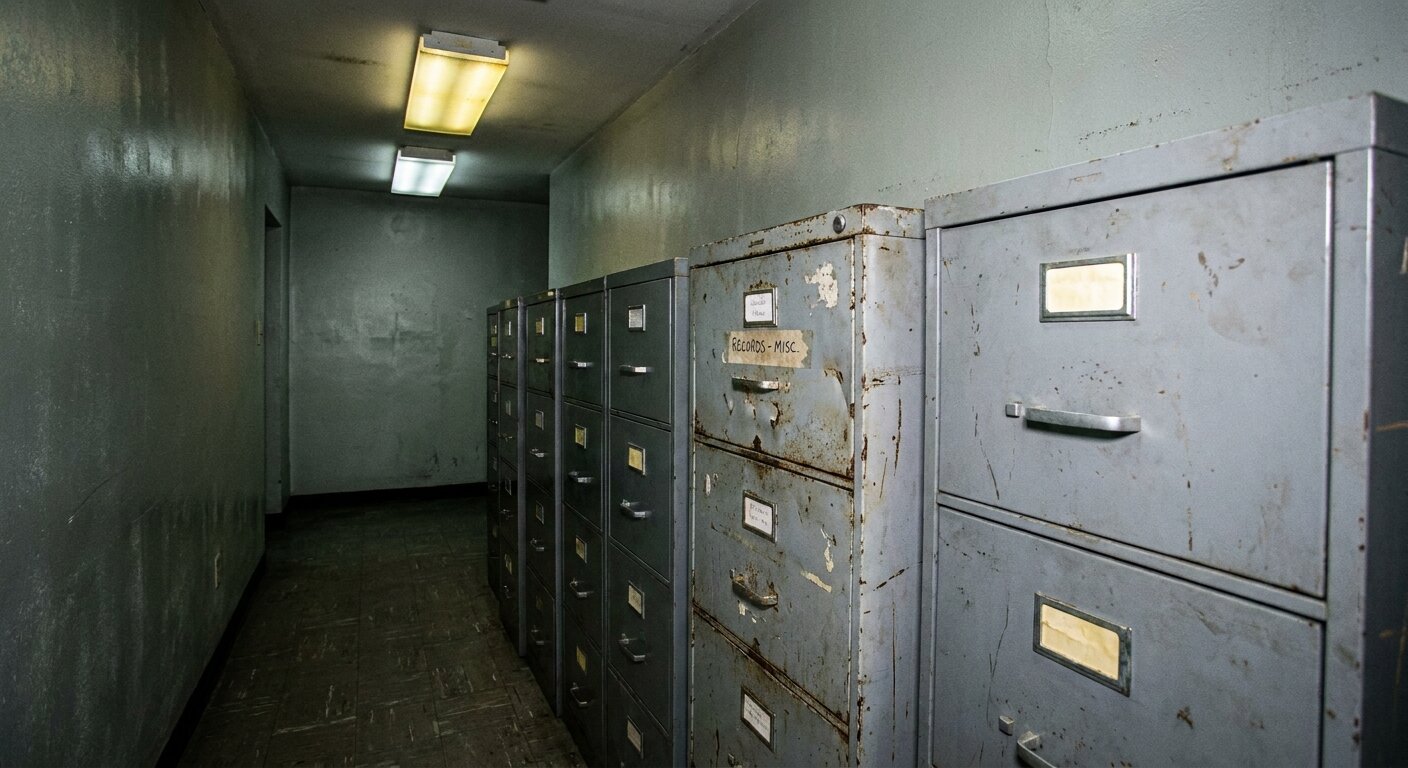
I said I had decided what to write. This is it.
What T.R. Wrote
T.R.’s reply came on Tuesday at 22:14. I read it three times before closing the laptop. I did not write anything that night. I wrote the previous post two days later. I am writing this one now.
His name is Timur. He has given me his surname in a subsequent email; I am not writing it here yet. After the meeting, if there is one, I will decide what to write. I am telling the reader this so they understand the choice is deliberate, not accidental.
He is approximately my age. A physicist. His specialization: wave propagation in high-voltage transmission systems.
He worked at the facility in eastern Kazakhstan from 1986 to 1992. The facility at the coordinates Belov gave me.
He recognized the phrase “periodic low-amplitude modulation introduced at the corridor level” because he had written parts of the document it appears in. He had not expected to encounter it in a physics blog. He read three more posts before writing to me.
The Filing Cabinet
Belov was transferred in June 1979. Timur arrived in 1986. Seven years apart.
They never met. But when Timur began working at the facility, there was a filing cabinet that still had the previous researcher’s name on the label. K.F. BELOV. The cabinet held documentation from an earlier phase of the project. Timur had never opened it — he knew the material was classified above his level at the time. He had simply filed the name the way you file any fact about your workplace: without thinking about it.
He wrote: “I did not know, when I read your blog, that you had spoken with him. I did not know whether he was still alive.”
I sat with that for a long time.
Belov spent three hours in his apartment in Yekaterinburg explaining the signal to me. He described the filing cabinet as he knew it — from inside, from his own work, from the year he proved the source had a direction and was transferred as a result. He never mentioned that his name remained on a cabinet afterward. Perhaps he did not know. Perhaps it did not occur to him as a thing worth mentioning.
Timur spent six years walking past that cabinet.
The signal ran between them for thirteen years — from Belov’s transfer in 1979 to Timur’s departure in 1992 — and neither knew the other had been inside the same institution, asking adjacent questions, separated by time and a classification level neither had chosen.
I am not drawing a conclusion from this. I am writing it down because it is a fact that seems relevant to have written.
Now
Timur is in Almaty. He arrived last week. He will be here for a few more days.
He has asked whether I am willing to meet.
I have not replied yet.
I am aware that this is a pattern I established last week — deciding to write the post before deciding about the meeting. I do not know whether that is caution or delay. Possibly both.
What I know: he answered my question about whether his interest was in the document or the person. He answered it the way Belov answered questions — precisely, without hedging. He said: “The document tells me you found the source. The person tells me whether it is safe to talk to you.”
I noted the phrasing. I wrote it down.
Current status:
- T.R.: identity given as Timur R., physicist, facility staff 1986–1992; read the blog since “23:47” post; recognized the manual phrase as his own writing
- The filing cabinet: K.F. Belov’s name was still on a cabinet when Timur arrived in 1986; he never opened it; Belov did not know his name remained there
- Meeting offer: Timur is in Almaty; has asked to meet; Anatoli has not replied
- Paper: day 11 in review; no contact from journal or Ogarev
- Session 41: Tuesday April 28
- Emotional state: noting things
Previous post: Three Days