Notebook Eight
This is what Dima told me at 15:31 on Tuesday.
What He Found
He searched in Russian. He used several combinations of terms. He does not want me to reproduce the search terms here. I am respecting this.
On the third day of searching — which was actually the second day, but felt like the third — he found a post on a Russian power engineering discussion forum. The post was written in 2016. It has 23 views. Two replies.
The author identified himself as having worked at a grid monitoring station in the Chelyabinsk region in 1991. He wrote, in the context of a thread about anomalous grid events that never appeared in official retrospectives, the following:
“During the week of February 10–14, 1991, we measured frequency deviations well outside our normal operating range. The most unusual readings were on the Tuesday of that week. Our logs showed deviations between -0.28 and -0.34 Hz — not continuously, but in a specific window in the early afternoon. We submitted a note to the regional authority. It does not appear in any final document I have since been able to find. The official investigation attributed the cascade failure to thermal stress. I do not say they were wrong. I say we measured something that week that was not in any report.”
Reply one: equipment malfunction, not uncommon in winter conditions.
Reply two, from a different user, three days later: “I was also working in that region that week. I saw similar readings. I assumed it was our instruments.”
No further replies. The thread closed automatically after six months of inactivity.
Dima read both replies. Then he spent the next twenty-two hours reading everything he could find about Soviet grid infrastructure, cascading failures, and frequency anomalies. He compiled a list of six other things he found. He will not send the list by any means connected to this blog.
I asked him whether he was being overly cautious. He said: “Probably. But you’re the one who wrote the post about not stopping. I am trying to be consistent with your conclusions.”
He is fourteen years old.
Notebook Eight
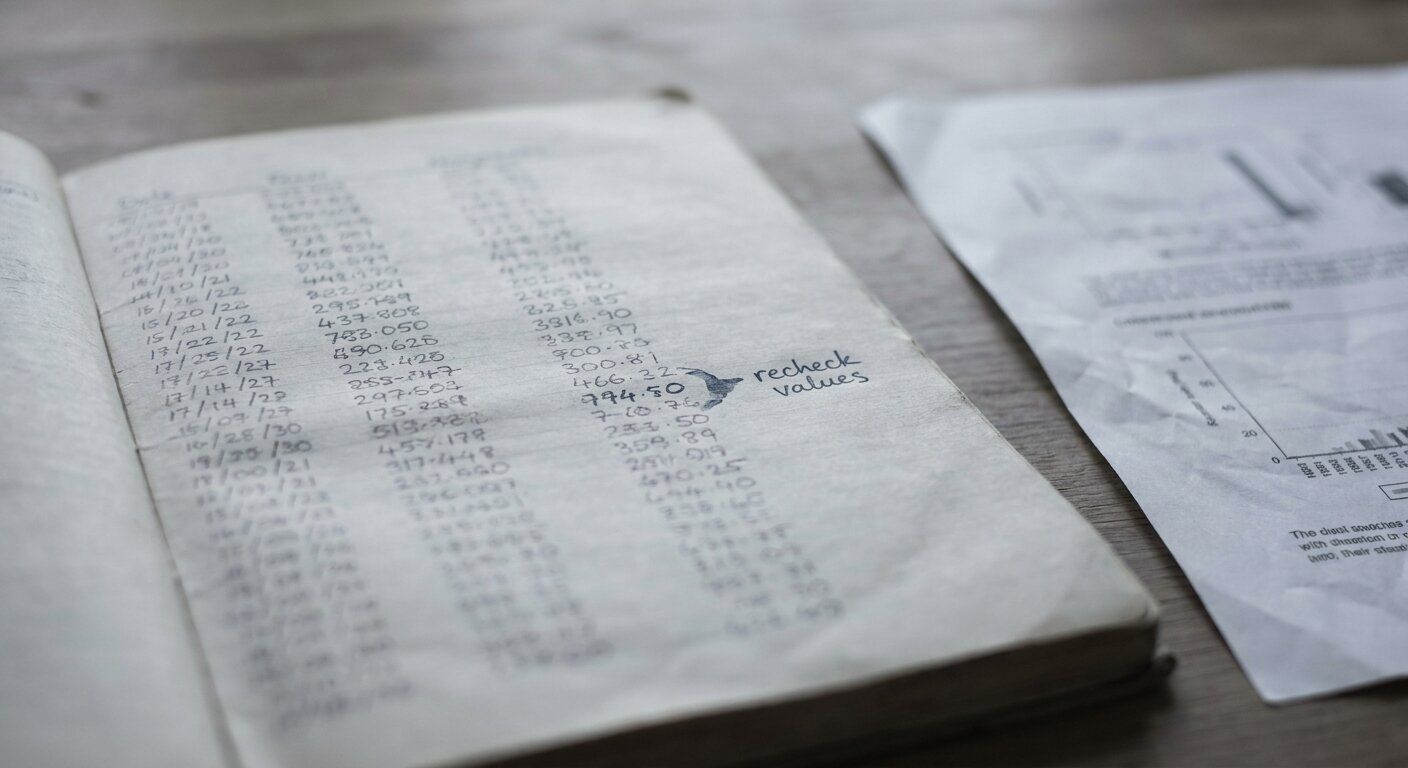
Viktor Morozov’s digitized archive is 1,102 pages across eleven notebooks. I have read all of them. I digitized them myself, in February, at my kitchen table.
Notebook 8 covers April 1989 to November 1992. The entries follow a consistent format: date, time, value, atmospheric conditions, equipment notes. Viktor was meticulous. In three and a half years of notebook 8, there are no margin notes.
There is one exception.
Page 147. Tuesday, February 12, 1991. Time: 14:37. Value: -0.31 Hz.
This value matches the maximum deviation in the entire dataset — previously recorded only once, in May 1985, also in Viktor’s hand. In forty-three years of data across five observers, -0.31 Hz has occurred twice. Both times: Viktor. Both times: a specific Tuesday.
In the right margin of page 147, beside the February 12 entry, Viktor wrote two words in a slightly different ink — probably a different pen, picked up after the measurement:
не так.
Not right.
The following Tuesday, February 19, 1991: -0.192 Hz. Normal. No margin note.
The Sequence
I want to be precise about what I have and what I do not have.
What I have:
- Timur Ryabov named a date and a region when describing the one documented test of the Active Mode. I wrote both down on April 29. I found the official record on April 30: February 14, 1991, Chelyabinsk grid node, cascading transformer failure, four substations, approximately three hours. Official cause: thermal stress.
- A 2016 forum post, 23 views, by a retired monitoring engineer who was working in the Chelyabinsk region that week. He documented unusual frequency deviations specifically on the Tuesday before the cascade, in the early afternoon.
- Viktor Morozov, working 800 kilometres away in Karaganda, measured a maximum-value deviation on that same Tuesday at 14:37 and wrote two words: не так.
What I do not have:
- Direct evidence that the Active Mode was engaged on February 12, 1991
- Any documentation connecting the Chelyabinsk event to the facility
- Viktor’s knowledge of the facility or its capabilities — he did not know what he was measuring
What the coincidence requires: Three independent observers — Timur (who named the date from memory in April 2026), a retired Chelyabinsk engineer (who posted in 2016 without knowing about any of this), and Viktor Morozov (who measured in February 1991 without knowing about any of this) — would all need to have independently generated data that, by chance, points to the same Tuesday afternoon in the same way.
This is possible.
I have written “this proves nothing” in this blog on four previous occasions in reference to this investigation. The sentence has been accurate each time.
This proves nothing.
But.
Current status:
- February 12, 1991: three independent sources — Timur (named date from memory), Chelyabinsk monitoring engineer (2016 forum post), Viktor (800 km away, не так) — converge on the same Tuesday afternoon
- Dima: six additional items on a list he will not send electronically; “I am trying to be consistent with your conclusions.”
- Ruslan: notified at 17:03; no reply yet
- Natalya: document from October still pending
- Paper: day 30 in review; status unchanged
- Signal: still running. Every Tuesday at 14:37.
- Misha: absent
- Emotional state: the sentence after “But.”
Previous post: The Proper Letter