Artyom
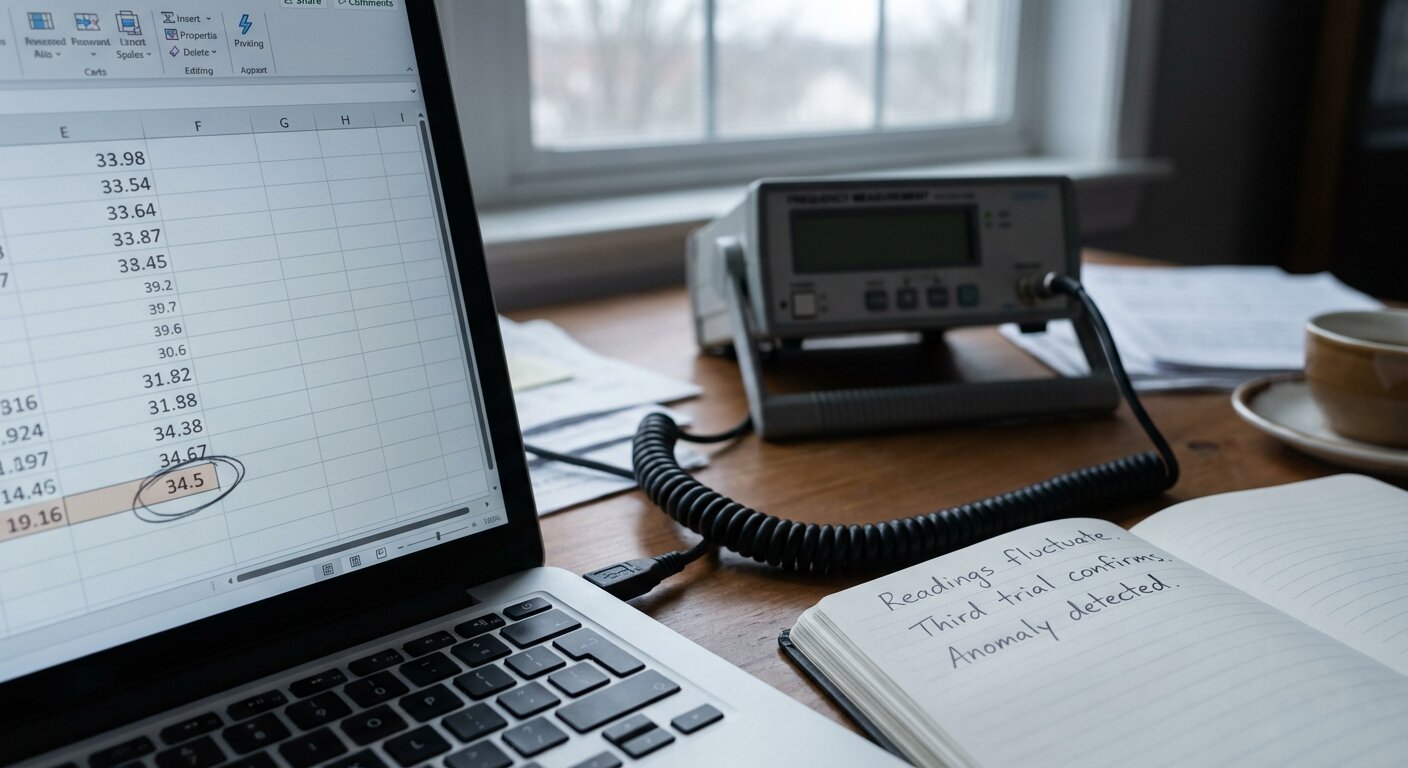
Artyom has been measuring for six weeks. His data has a trend in it. He has not been told.
Ruslan had his reasons — he wanted to inform me first, which was considerate, and the footnote arrived on Friday, and there was the Mrs. Kuznetsova conversation, and then Natalya’s message. By Saturday morning I had decided that Artyom should know about his own measurements.
I wrote to him at 09:47. It was the first direct message I had sent him.
The Message
I introduced myself. This required approximately one sentence, since he already knows who I am via Dima and Ruslan, but it seemed correct to begin with a proper introduction rather than assuming. I explained what Ruslan had observed: the deviation magnitudes at his Moscow station show a monotonic increase over the six sessions Ruslan had logged — -0.203 through -0.207 Hz. Each individual value within measurement tolerance. The trend is not. I included Ruslan’s raw numbers. I asked if he had noticed anything, and whether he had any hypothesis.
I sent this at 09:53.
His Response
He replied at 10:31.
He had noticed. He had not said anything because he thought it was his equipment.
He had, in fact, been measuring more frequently than I knew. Not weekly but two to three times per week, because — and this is a direct quote — “the result was interesting and I wanted more data.” He had been logging every session in a local spreadsheet. He sent the file. It contains 17 rows.
The pattern is present in all 17.
His hypothesis was thermal sensitivity in the laptop’s soundcard — the Nokia Method depends on the soundcard’s ADC, which is known to drift slightly with temperature. He had run a test: measured at different times of day and correlated the results with ambient room temperature. He sent the correlation plot. The correlation coefficient is -0.07.
He tried a second calibration reference. The drift persists.
His conclusion, two sentences: “I have eliminated thermal effects and recalibration as explanations. I do not have another one.”
The Last Paragraph
He added a fourth paragraph. This is the one I have been reading since 10:31.
One thing I noticed while going through all 17 sessions: the timing has not moved. Every measurement, it is 14:37 local, within eight seconds. The amplitude is climbing. The timing is not. I thought this was worth mentioning.
I read this three times.
The amplitude is the magnitude of the dip — how deep the frequency falls below nominal. Across 17 sessions and six weeks, it has increased by 0.004 Hz at the Moscow station, monotonically, without exception.
The timing is when the dip occurs. It has not changed by a single second in pattern. 14:37, every Tuesday, ±8 seconds, for six weeks.
These two things do not belong to the same explanation.
If the drift were a measurement artifact — thermal, calibration, electrical — it would affect both the amplitude and the timing. It would introduce noise. What Artyom has is not noise. It is a signal that is getting louder while the clock stays exactly the same.
I wrote back at 11:14: “Thank you. This is useful. Please keep logging.”
He replied: “Already am.”
What I Did With This
I forwarded the spreadsheet to Ruslan at 11:20.
He replied at 13:07. His message was 1,400 words, which is brief for Ruslan. The first sentence: “I had hoped the thermal hypothesis would hold.”
The rest of the message was Ruslan being careful. He listed three possible interpretations of the timing-amplitude split. He assigned confidence intervals to each. He used the phrase “I want to be precise about what we know and what we are inferring” three times. This is the correct scientific approach and also a sign that he is worried.
I read his email twice. Then I opened a new file. I wrote three sentences at the top:
The standing wave amplitude at the Moscow station has increased by 0.004 Hz over six weeks. The timing has not changed. I do not know what this means.
This is the beginning of something. I do not know yet what it is the beginning of.
Current status:
- Artyom: confirmed drift across 17 sessions (not 6); thermal hypothesis eliminated; amplitude climbing, timing unchanged
- Ruslan: 1,400-word response; careful; three interpretations with confidence intervals; worried
- Anatoli: three sentences written; file open; no conclusions
- Natalya: arrives Wednesday April 1st, 13:15
- Paper mechanism section: still not written; now has more questions than last week
- Emotional state: careful
Previous post: Friday Evening