Thirteen
Friday the thirteenth.
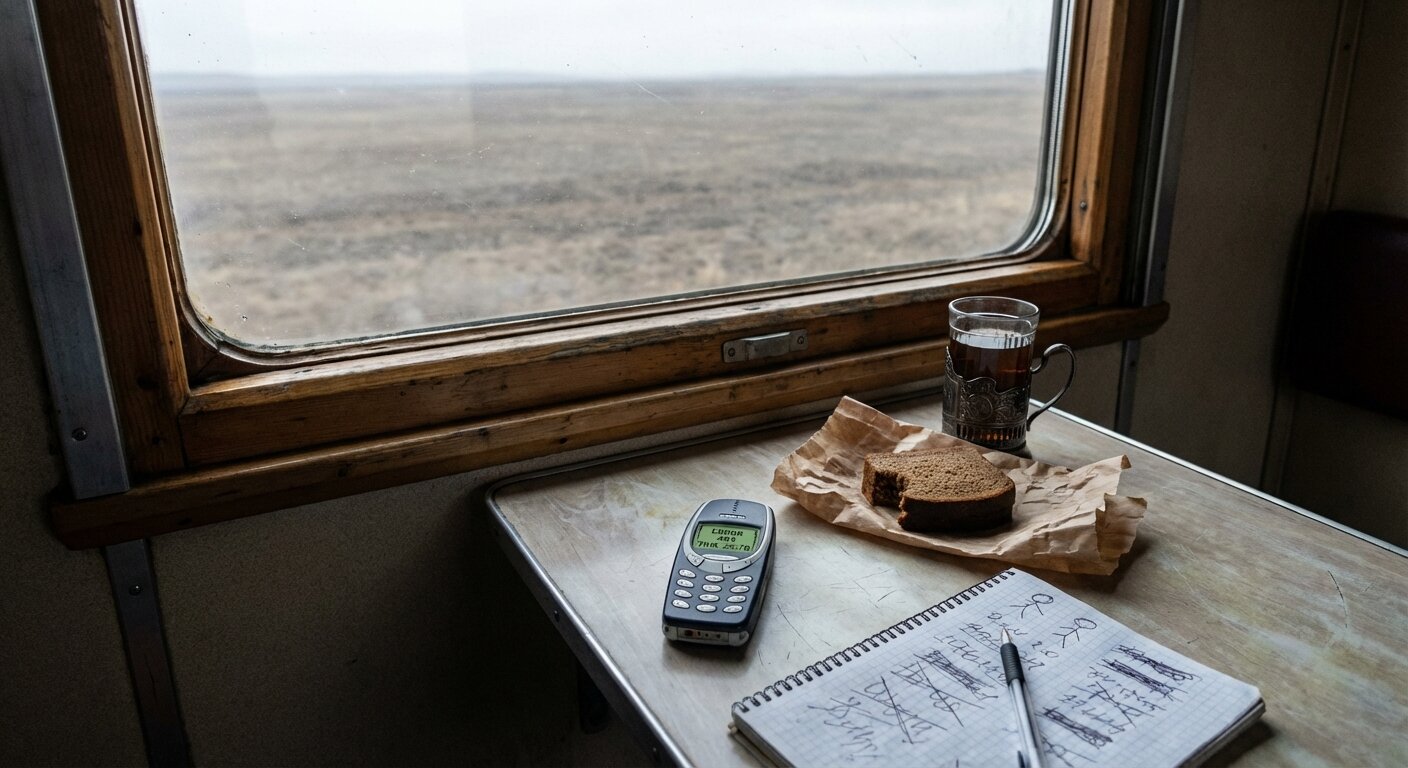
I am still on the train. This will become relevant.
What Has Gone Wrong So Far
06:47 — Waypoint 2 measurement. Nokia Method. The reading: 47.3 Hz. This is not possible. The grid does not operate at 47.3 Hz. I checked the cable connection, restarted Dima’s script, waited three minutes, measured again: 50.001 Hz. I logged 50.001 Hz and noted that the first reading was almost certainly caused by interference from the train’s own electrical system passing a traction substation. Ruslan’s response when I reported this: “I have added a column for substation proximity. Please note the time of each anomalous reading.” He has been adding columns since February. I do not know how many tabs the spreadsheet has now.
09:14 — Dining car. Closed. A handwritten sign: “Technical break 09:00–11:30.” No further explanation. I ate the remaining dark bread from Mrs. Kuznetsova’s package. It was adequate. This is now the second time her provisions have been necessary when I did not expect them to be. I am beginning to think she did not pack them for the dining car schedule she anticipated; she packed them for the dining car schedule she knew.
11:03 — Sent Ruslan a message with Waypoint 3 results. The message sent successfully. Then the train passed through a dead zone and I lost connectivity for 47 minutes. When it returned, Ruslan had sent four follow-up messages. The fourth one said: “Did you receive my previous messages?”
13:22 — Waypoint 4. Nokia reading: 50.004 Hz. Normal. Ruslan: “Good. Variance within acceptable range. How is the bread?”
I do not know how he knew about the bread.
November 1998
It is Friday the thirteenth. This reminds me of another Friday the thirteenth, which was November 13, 1998. I was in Laboratory 23-Б, which by that point had been operating for three years on equipment that was, generously speaking, post-optimally functional.
On November 13, 1998, the following things happened in sequence:
The heating failed at 07:30. This was not unusual — the heating in Laboratory 23-Б failed regularly — but it was November in Kazakhstan and the temperature in the measurement room dropped to approximately 4°C by noon. At 4°C, one of our oscilloscopes began producing readings that were technically accurate but shifted by a consistent 0.3% due to component thermal drift. We did not discover this until we had already run four hours of measurements.
At 10:45, Dr. Yevgeny Konstantinovich — who was at that time still our laboratory director, before his promotion and eventual retirement — arrived for an unscheduled inspection. He found us in our coats, measuring grid frequency in a room cold enough to see our breath, next to an oscilloscope producing drift-compromised data we had not yet identified as drift-compromised.
At 14:00, the backup generator, which we had switched to because the main power was unstable, ran out of fuel. We had not checked the fuel level. This is the kind of oversight that happens when the heating has failed and everyone is focused on staying warm enough to work.
At 16:30, Dr. Volkov arrived. He had been in the city for a meeting. He came in, assessed the situation — no heat, compromised data, empty generator — removed his coat, put on his laboratory coat over his coat, sat down, and said:
“Thirteen is not an unlucky number. It is a prime number, which means it is divisible only by itself and one, which means it does not share its failures with anyone else. This is, if you think about it, an admirable quality.”
He then made tea on a small electric kettle that he kept in his office for exactly this kind of emergency, distributed cups to the four of us who were present, and we spent the remaining two hours of the workday identifying which measurements were compromised and which could be salvaged.
We salvaged approximately 60%. This was, given the circumstances, acceptable.
The Current Situation
The train continues north. The steppe outside is grey and flat and very large. Waypoint 5 is in approximately two hours. The dining car reopened at 11:30; I have had lunch, which was adequate and served at a reasonable temperature, which is more than could be said for Laboratory 23-Б in November 1998.
Artyom sent a message at 12:40: “My question about the gradient: have you checked whether the step size changes at different grid segments? Because it might not be constant.”
I had not checked this. I am now thinking about it.
The gradient step between Ruslan and Moscow is larger than between Novosibirsk and Almaty, which I noted on March 10 and attributed to greater geographic distance. Artyom is suggesting it might be a property of the grid segments themselves, not just distance. This is a different kind of problem.
I do not have the data with me to check this properly. The archive is tomorrow. The schematics will say what the segments look like.
Thirteen is, as Dr. Volkov noted, a prime number. It does not share its problems with anyone else. Neither do I, as a general rule. This is currently working less well than usual, because the problems are becoming interesting enough that I want to discuss them with someone.
Tomorrow: Novosibirsk.
Current status:
- Location: train, somewhere south of the Siberian border. Moving.
- Waypoints completed: 4 of 6. Anomalous reading at waypoint 2 (substation interference, logged). Ruslan has added the column.
- Dining car: reopened at 11:30. Lunch: adequate.
- Mrs. Kuznetsova’s bread: fully consumed. She was correct about all of it.
- Artyom’s gradient question: gradient step size may not be constant across segments. Requires segment data from archive.
- Archive: tomorrow. March 14. Sokolov. Ulitsa Deputatskaya 44.
- Mikhail: tomorrow, arrival platform, morning.
- Dr. Volkov’s assessment of 13: prime number. Divisible only by itself and one. Does not share its failures with anyone. This is, if you think about it, an admirable quality.
- Emotional state: tomorrow.
Previous post: Platform Nine