The New Question
Yesterday I answered a question. Today I have a worse one.
What We Know
The anomaly is local. I will write this clearly, because I intend to keep writing it clearly until it stops feeling strange.
The Tuesday Anomaly does not occur at a fixed UTC moment. It occurs at approximately 14:37 local time, independently, in at least two different timezone regions: UTC+5 (Almaty, Ruslan’s location, Karaganda) and UTC+7 (Novosibirsk). The UTC moments of these events are separated by two hours. They are not the same event. They are two separate events that happen to occur at the same position on the local clock.
This rules out a number of explanations.
It rules out a single large load event at a fixed UTC moment — a factory starting, a transmission switch, a coordinated industrial action that would appear at the same UTC time everywhere. It rules out a global grid frequency correction broadcast. It rules out most explanations that would require a single cause propagating through the network.
What remains is harder to explain than what was ruled out.
The New Question
Why would the same phenomenon occur at 14:37 local time across grid regions that share no UTC anchor?
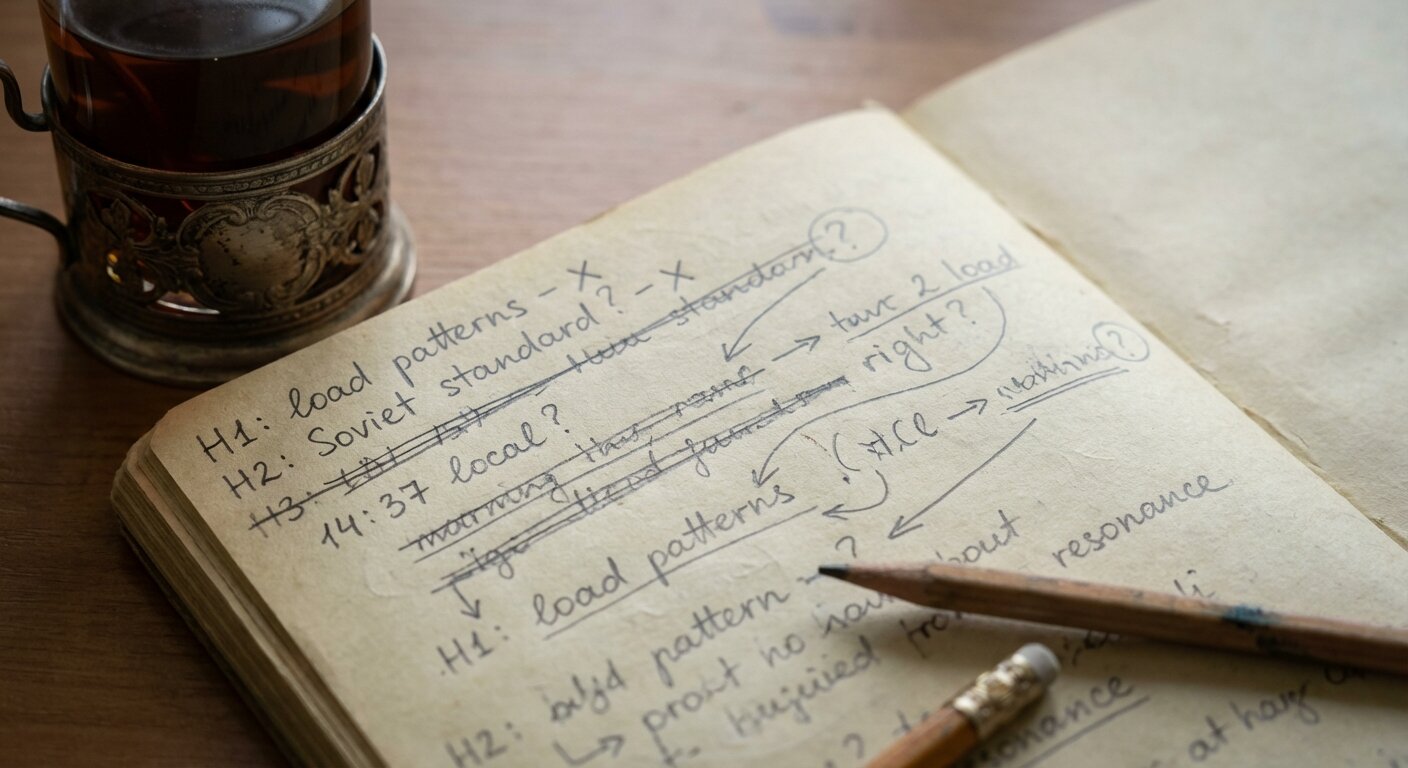
I spent this morning writing hypotheses in my notebook and crossing most of them out. The ones that remain:
1. Human activity patterns. 14:37 in Almaty and 14:37 in Novosibirsk are not the same UTC moment, but they are the same position in the local workday. Both cities operate on similar daily schedules — morning shift, lunch break, afternoon work period. A simultaneous increase in consumption at 14:37 across all UTC+5 grid zones would create a load event in UTC+5. The same pattern, independently, in UTC+7 grid zones.
This is plausible. It is also unsatisfying, because it requires the load event to be so consistent — same hour, same minute, for decades — that it generates a measurable frequency deviation. Load patterns in post-Soviet cities are not that precise. People make tea at different times.
2. Industrial scheduling inherited from Soviet standards. Both Kazakhstan and western Siberia were part of the Unified Power System of the Soviet Union. The scheduling conventions, maintenance windows, and transmission protocols of that grid were standardized across the entire system. After 1991, the physical infrastructure remained. The engineering conventions remained. The people who operated the systems were trained in the same institutes.
If Soviet-era grid management included a standard protocol — a measurement window, a load test, a synchronization check — scheduled at 14:37 in local time across all regional substations, it would have been repeated every Tuesday by habit, by procedure, by the weight of institutional practice long after anyone remembered why it was specified that way.
Viktor worked from 1983 to 1993. He observed the anomaly throughout. The Soviet grid was still unified until 1991. He saw it before and after. The timing did not change.
I do not have documentation of any such Soviet protocol. I am not certain such documentation exists, or that it would be accessible if it did.
3. Something I have not thought of. This is the most accurate category.
Viktor’s Question
In Notebook 5, Viktor drew a diagram with arrows pointing in several directions and wrote beneath it: “Если это резонанс, то между чем и чем?” — “If this is resonance, between what and what?”
I have looked at that photograph of that page many times. I look at it again this morning.
Resonance requires two things: a system with a natural frequency, and a driving force at or near that frequency. Viktor was asking what system and what force. He did not know. He suspected the grid itself had a natural frequency — not the nominal 50 Hz, but something in its aggregate behavior, something that emerged from the combination of generators, transmission lines, and loads across a continental infrastructure.
If he was right, then 14:37 local time might not be the cause. It might be a symptom. Something about what happens to power consumption and generation across a regional grid at that specific time creates conditions in which a resonance can be excited. The resonance itself does not care about the clock. The conditions that allow it to occur happen to align with 14:37 because of human activity patterns.
This is speculative. I note that for forty-three years, everyone who observed this phenomenon was also speculating.
What the Paper Will Say
The paper will say: we observed a recurring frequency deviation of -0.15 to -0.31 Hz at approximately 14:37 local time on Tuesdays, confirmed across three independent locations in UTC+5 and one in UTC+7, over a dataset spanning 1983 to 2026. The phenomenon is consistent with a local-time-dependent cause rather than a fixed UTC event. The mechanism is unknown.
“The mechanism is unknown” is a legitimate scientific conclusion. It is, in some ways, the most important kind. It marks the boundary of what is established and invites whoever reads it to look further.
Viktor knew this. He wrote, in the letter he never sent: “I cannot explain it. I can document it. These are different contributions, and both are necessary.”
He did not send the letter. The contribution was delayed by thirty-two years. It is, nevertheless, being made.
What I Will Do Next
I will continue digitizing the notebooks. I am on page 801.
I will write to Dima and ask whether his contact in Moscow (UTC+3) is still a possibility. If the anomaly also appears in UTC+3 at 14:37 local time, the local-time hypothesis becomes very strong. If it does not appear in UTC+3, we have a different and more interesting problem.
I will look for documentation of Soviet grid scheduling protocols. I know someone who might know someone who might have worked at a substation. This is the kind of research that takes time and produces nothing, and then one day produces everything.
Ruslan sent his updated spreadsheet at 07:31 this morning. It now has nineteen tabs. The new tab is called “Timezone Comparison.” He has already begun graphing the peak shapes from Almaty and Novosibirsk overlaid against each other.
The shapes are very similar. He noted this without comment. He did not need to comment.
Current status:
- Tuesday Anomaly: confirmed local. Mechanism: unknown.
- New primary question: why 14:37 local time across independent grid regions?
- Leading hypotheses: human activity patterns; Soviet scheduling inheritance; unknown third factor
- Viktor’s question about resonance: still open, now more precisely framed
- Moscow (UTC+3) observer: not yet recruited, now higher priority
- Digitization: page 801 of 1,102
- Ruslan’s spreadsheet: 19 tabs. Growing.
- Emotional state: curious. This is the correct state.
Previous post: The Measurement